
Printing Errors in Stickers and Trading Cards: When a Flaw Can Make All the Difference
In the world of sticker and sports trading card collecting, printing errors are among the most fascinating aspects of the hobby. However, it's important to dispel a common myth: not every rare sticker owes its value to a production mistake. In many cases, rarity is the result of limited print runs, uneven distribution, or specific production circumstances.
The Most Common Errors
Over the years, publishers?Panini above all?have had to correct numerous mistakes before or during the distribution of their collections. The most common examples include:
Incorrect or outdated team jerseys.
Photos assigned to the wrong player.
Errors in player positions or personal information.
Actual mix-ups where one player's photo was mistakenly used for another.
When these issues were discovered, the sticker was corrected and reprinted. As a result, two versions of the same sticker could exist: the original version containing the error and the corrected edition.
(Trading card created artificially after the move from Juventus to Vicenza)
Why Some Stickers Become Hard to Find
A reprint does not necessarily mean that both versions were distributed in the same quantity or in the same way. In fact, the opposite was often true.
The first print runs usually reached newsstands quickly and were widely distributed. Corrected versions, printed later, might only reach certain regions or be released in different quantities. In other cases, the original error was withdrawn almost immediately, making it far more difficult to find years later.
For this reason, a sticker's rarity depends not only on how many copies were printed, but also on when, where, and how they were distributed.
Condition Plays a Major Role
Just like coins, stamps, and other collectibles, the condition of a sticker or trading card has a significant impact on its value.
A perfectly preserved sticker will almost always be worth more than the same item showing creases, scratches, or signs of wear. Many vintage stickers remained protected inside albums for decades and, if attached with easily removable glue, can still be found in excellent condition today.
Of course, a rare sticker in poor condition may still attract collectors, but its market value will generally be lower than that of a well-preserved example.
(Sticker with different coloring/lettering)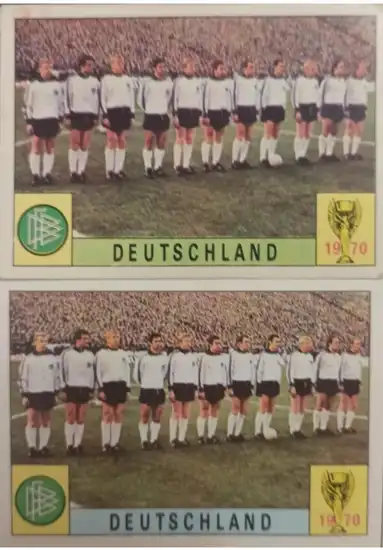
The Same Applies to Modern Trading Cards
Printing errors are not limited to vintage stickers. Modern sports trading cards also feature examples of printing mistakes, off-center cuts, color variations, incorrect text, and image mix-ups.
Sometimes these errors are corrected quickly by the manufacturer, making the original versions highly desirable among collectors. In other cases, they are simply production defects with little or no effect on market value.
When Does an Error Really Increase Value?
There is no universal rule that applies to every collection. For a printing error to become truly valuable, several factors come into play, including the number of copies that actually reached the market, the popularity of the collection, collector demand, and how easy it is to obtain the corrected version.
That is why not every printing error automatically turns a sticker or trading card into a rare collectible. Some become highly sought-after pieces, while others remain little more than interesting production curiosities.
Understanding the history of different editions, reprints, and distribution methods is often the best way to determine which printing errors have gained genuine collector value over time?and which have not.
Editorial staff