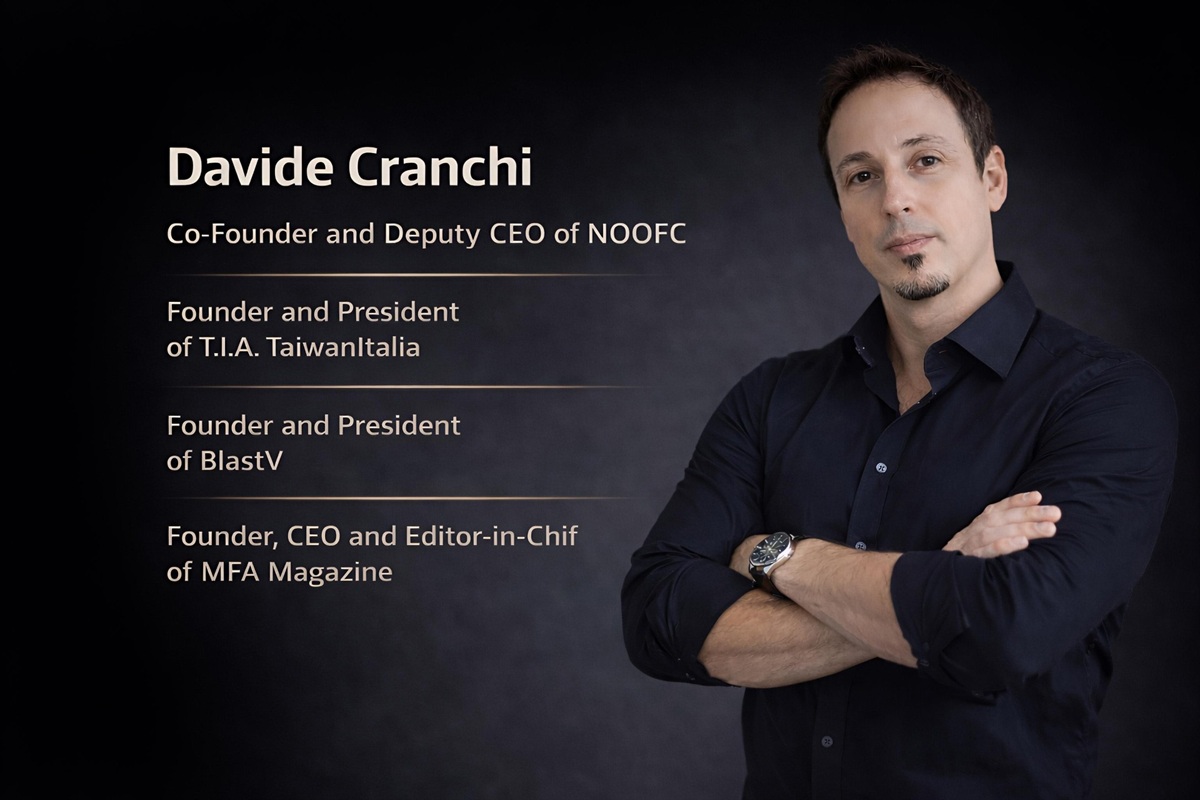
INTERVIEW DAVIDE CRANCHI : M.F.A. MAGAZINE
The Beginning of Everything.
The thought, the journey, and the identity behind a magazine that's about to be born!
1 ) Introduce yourself
My name is Davide Cranchi, and throughout my life I have always believed in one very simple principle: that true projects are not created merely to occupy a space, but to leave a mark.
I am an Italian entrepreneur living in Taiwan, but before that, I am a person who loves to build bridges where others see only distance. Bridges between cultures, between people, between worlds that may appear far apart, yet which, once they find the right language,discover that they are able to move in the same direction.
Over the course of my journey, I have brought to life different ventures, all united by the
same vision: to create value, create connections, and create the future. On one side
stands the world of business and international communication, with NOOFCi, where I have pursued an idea of marketing not as mere publicity, but as a strategic force capable of giving projects identity, presence, and authority. On the other stands my associative and cultural commitment in Taiwan, where I have sought to build a point of reference for Italians and, at the same time, an open door for all Taiwanese who look toward Italy with curiosity, respect, and passion.
I believe deeply in the value of representation. I believe that whenever a person acts with
seriousness, he never represents only himself. He represents a history, a culture, a
sensibility, a way of being in the world. And I, as an Italian in Taiwan, have always felt
both the duty and the honour of carrying with me a certain style: that of vision, quality,
keeping one's word, and ambition accompanied by a genuine appreciation for things
done well.
Yet alongside the entrepreneur stands also the man who observes, who creates, who
feels. Because I am also an artist, and art has taught me that it is not enough to build
something that simply works: one must build something that speaks, that moves, that
endures. It is perhaps precisely from this meeting point between enterprise and
sensitivity, between strategy and intuition, between practicality and imagination, that
my way of seeing the world is born.
In recent years I have felt, more and more strongly, another responsibility: the one towards young people. Because a society that is unable to offer its youth ideals, tools, discipline, examples, and genuine opportunities is a society that risks losing its direction. That is why I look with conviction toward everything that can educate, shape, and elevate:
culture, reading, community, and team sports, particularly football.
To me, football possesses a unique appeal, because it is perhaps the team sport that more than any other brings together strategy, vision, intelligence, sacrifice, and a true collective spirit. It is a fast, dynamic game, played across a broad space, capable of changing shape in an instant, and for that very reason it does not forgive individualism. If you do not truly know how to play with others, if you do not know how to read movement, if you do not know how to trust, help, cover, wait, and move forward together, then it becomes exceedingly difficult to play well.
And it is precisely here that football reveals its greatness: it is not only technique, it is not
only running, it is not only talent. It is harmony among people. It is the place where individual talent encounters collective discipline. And when that happens, something extraordinary takes place: not only does the player grow, but the person grows. That is why the projects I value most are always those that possess a soul. Those that do not merely chase success, but seek to deserve it. Those that do not limit themselves to producing results, but aspire to generate meaning. Those that are not satisfied with simply appearing, but wish to leave a real impact on people's lives.
If I had to express in a few words what guides me, I would say this: the will to build with
courage, with elegance, and with vision. Because in life, as in football, one may have a
strong attack, one may possess imagination, one may possess technique. But if there is no
vision of the game, if there is no ability to read the field, if there is no sense of the team, one does not go very far.
I continue to believe that the future belongs to those who know how to bring different
worlds together, to those who know how to speak to people with sincerity, to those who
know how to turn an idea into a project and a project into a reality. And that is exactly
what, every single day, I strive to do.
Because in the end, in every sphere of life, the same rule always applies: collaboration
always triumphs over distrust.
2) In your editorial, you speak of a very strong conviction: that football can be education, culture, and community. When did you first realise it could be something more than a sport?
I realised it when I began to look at football not only through the eyes of someone watching a match, but through the eyes of someone observing people. Because football, when it is genuine, is not only competition: it is character, discipline, respect for one's role, and the ability to belong to a team without losing one's own identity.
At a certain point, I understood that around a ball you do not form only players: you form friendships, sporting families, even a way of standing in the world. And then I understood something very simple, yet very powerful: football can teach young people how to fall and get back up, how to win without arrogance, how to lose without excuses, how to live alongside others. And when something shapes character, creates a shared language, and brings people together, then it is no longer just sport. It becomes culture. It becomes community.
3) You emphasised that this magazine was born from a vision shared with other people. How important was it to build this project together rather than individually?
It was decisive. The things that truly matter, the ones capable of leaving a mark, are never born from an individual idea alone. They may begin with one person, certainly, but to become something meaningful they need to meet other visions, other energies, other deep convictions.
In this project, it was essential for me to find in Daniel Calvert and Michael Chandler, the founders of MFA, not only two highly capable professionals, not only two men of football, but two people moving in the same direction as I am. In them I did not simply see coaches who want to win; I saw people who sincerely believe in what football can give to a young person: discipline, confidence, character, belonging, and perspective.
And that is precisely what made everything stronger. When several people share not only a goal but also a meaning, the project rises to another level. It is no longer a personal initiative: it becomes a real, solid, credible construction. I believe deeply in this principle: individual talent may ignite a spark, but only a shared vision can turn it into a flame that endures over time.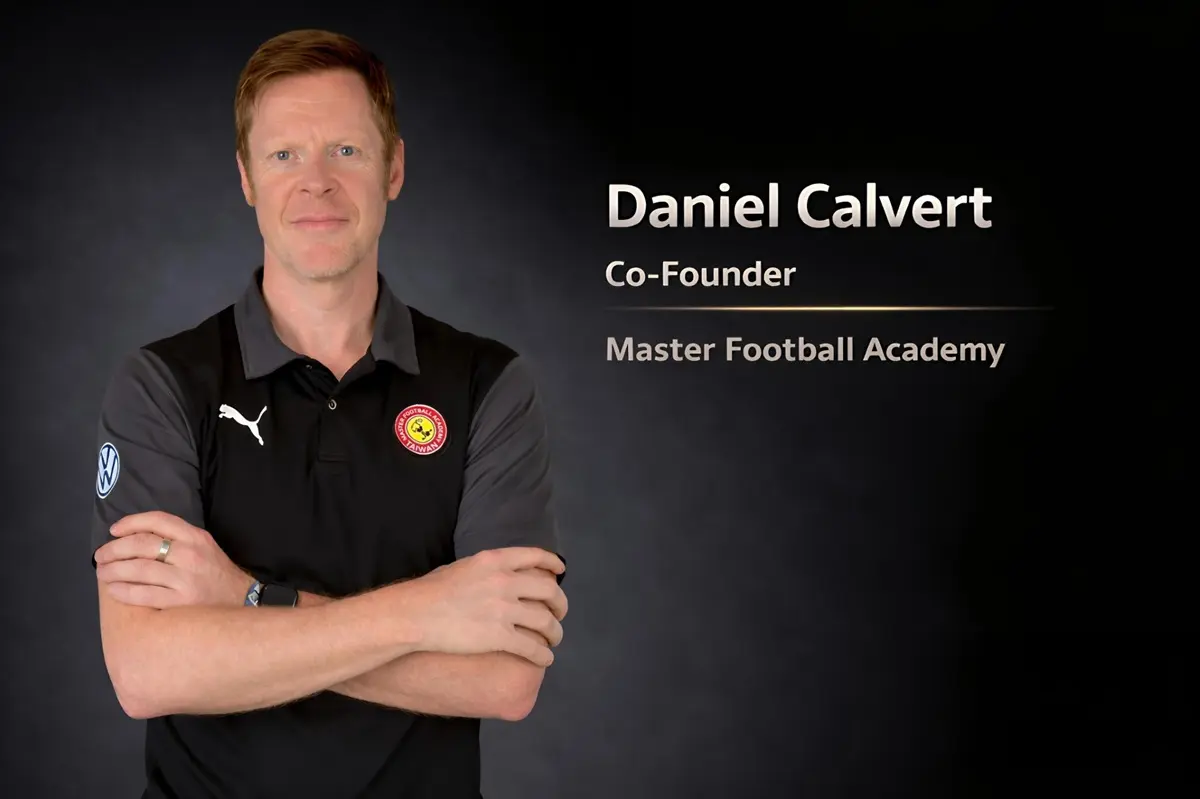
4) You clearly said that you did not want a magazine made only of results and league tables. In your view, what is missing today in the way football is told?
What is missing is the soul. Too often today, football is told as a constant stream of numbers, controversies, performances, standings, and the algorithms of the moment. Everything is fast, everything is noisy, everything is consumed in a matter of seconds. But in that process, the most important part is lost: the human meaning of football.
I do not dispute the result. The result matters. It would be a mistake to think otherwise. But the result alone explains nothing. It does not tell the story of a boy's sacrifice, a parent's patience, a coach's quiet work, or the educational value of a group. Today we speak too much about the "how much" and too little about the "why". And yet football deserves to be told also as a school of life, as a social mirror, as a place in which a community recognises itself.
5) You made a countercurrent choice by investing in print. Why, in a digital world, do you regard paper almost as an "act of elegance"?
Because today paper is almost a form of respect. Respect for the content, respect for the reader, respect for time. In the digital world, everything arrives at once: notifications, messages, constant prompts, every possible distraction. It is a world that often gives you no real time to stop. Paper gives that space back to you. It allows you to read, to think, to absorb, to pause over a sentence without being interrupted every moment by a sound, an alert, or a message dragging you somewhere else.
For me, this is a central point. A printed magazine does not chase me, does not pull at me, does not try to steal my attention with the anxiety of immediacy. It invites me into a more serious, more orderly, deeper kind of time. And in that, yes, I see an act of elegance. Because elegance is not only aesthetic: it is also measure, quality, attention, and the ability to give value to things without shouting.
To choose paper today also means affirming a precise idea: not everything must be consumed in haste. Some content deserves to be read calmly, understood fully, almost safeguarded. That is why, in an age that never stops running, I do not see paper as nostalgia for the past, but as a modern and courageous Choice.
6) You speak of reading as a slower and deeper experience. Do you think this slowness can also have an impact on the growth of young people?
Yes, I believe so very strongly. In fact, I would say even more: today, slowness for young people is not a limitation. It is a form of inner education. We live in a time in which young people are constantly stimulated, distracted, and broken into a thousand fragments of attention. And a fragmented mind struggles to become a strong mind.
Slow reading teaches concentration, depth, and even the taste for complexity. A young person who learns to read well also learns to think better, choose better, and speak better. And whoever thinks better is freer, less manipulable, and more capable of building his or her own future. That is why I see reading not as a secondary habit, but as a training ground for conscience.
7) The magazine includes a technical section designed also for parents. How important is it, for you, to bring football back into the family relationship?
It is extremely important, because youth football is not played only on the pitch. It is also played on the touchline, in the car after training, at the dinner table, in the way a parent looks at a mistake or a defeat. If we truly want a young person to grow well, we must also help the environment around that young person to grow.
That is why I wanted a technical section that also speaks to parents. Not to turn them into coaches, but to make them allies in the educational journey. A parent who better understands the game, the timing of development, the meaning of mistakes, and the logic of formation becomes a more intelligent and more useful source of support. And when family and football stop being two separate worlds and begin to speak to each other, the young person grows with greater balance, greater serenity, and greater Strength.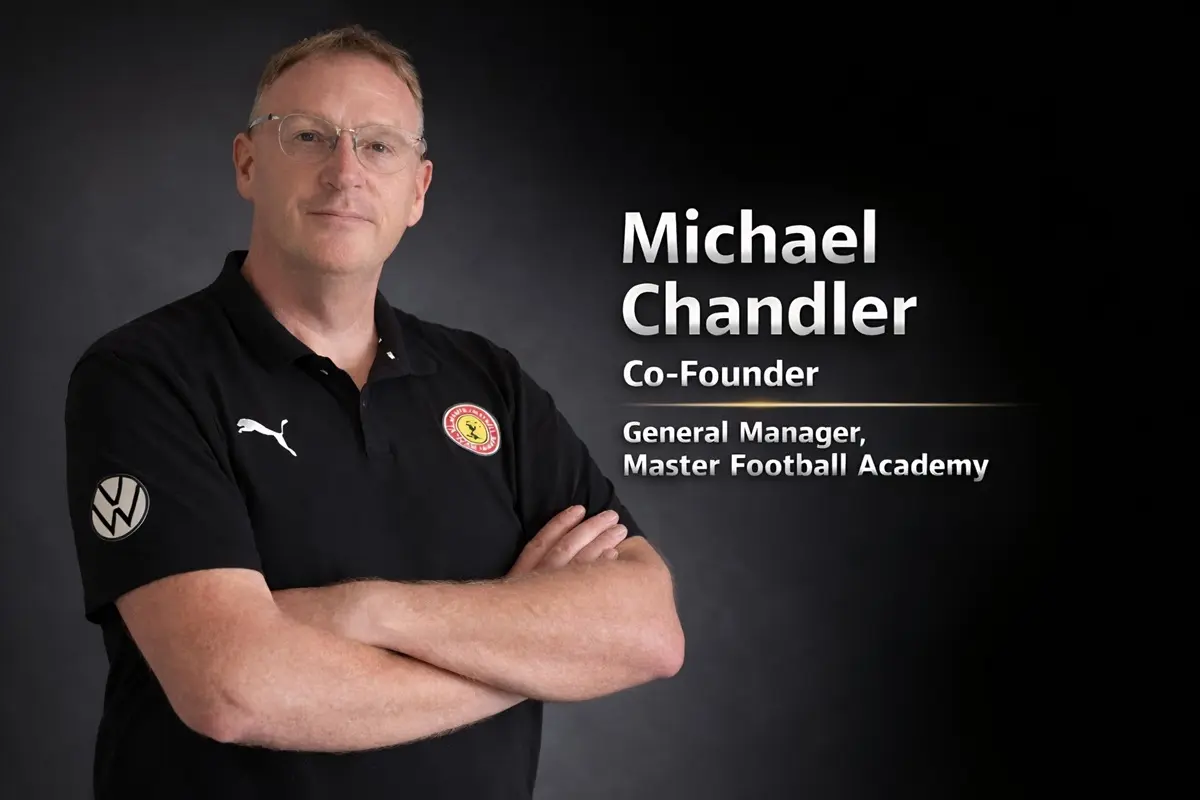
8) You say that today we are often physically close but mentally distant. Can football really become a tool to bridge this distance? How?
Absolutely, yes. Because football, when lived in the right way, demands presence. Real presence. On the pitch you cannot be somewhere else in your mind. You must listen, intuit, trust, and sacrifice something of your own for the good of everyone. It is an extraordinary training ground against the mental loneliness of our time.
But there is more. Football creates genuine opportunities for encounter. It makes sons speak with fathers, parents with coaches, young people with one another, families with other families. It rebuilds a fabric. It transforms physical closeness into shared experience. Today we have homes full of people and, too often, silences full of distance. Football can break that distance because it puts gesture, eye contact, trust, and mutual responsibility back at the centre. In one word: relationship.
9) You wanted to include a section dedicated to the history and culture of Taiwan. Why did you feel the need to connect football with the knowledge of roots and identity?
Because I believe that for a young person truly to grow, he or she must know not only the field on which he or she plays, but also the land on which he or she walks. To know the history of one's country, to understand what it has gone through, what difficulties it has overcome, what sacrifices were necessary to arrive here, means building within oneself a deeper, stronger, truer sense of consciousness.
I wanted to connect football with the history and culture of Taiwan for precisely this reason: there is no sporting identity without human identity. A young person who knows his or her roots is not only more aware, but also more motivated. And one day, when that young person competes at the highest levels, he or she will not carry only himself or herself onto the pitch, but will carry in the heart the country, the people, and the history from which he or she comes.
And I think that makes an enormous difference. Because when you fight and you know what you are fighting for, you fight better. You fight with greater hunger, greater dignity, greater strength. You are not playing merely to win a match: you are playing to bring pride to the country that raised you, formed you, and gave you the chance to get that far.
For me, this is a fundamental point: football must not detach young people from their identity; it must strengthen it. It must help them understand that representing a place, a culture, a history is not a burden: it is a privilege. And it is precisely from that awareness that not only a better athlete can be born, but also a better person.
10) You close with a very important phrase: "team play always wins". What does it truly mean today to be a team in life as well as in sport?
It means understanding a truth that is very simple, yet also very great: alone, one may perhaps move faster, but only together can one build something that truly lasts. And this is true in sport, in work, in family, in society. It is true wherever there is something important to defend, to grow, and to carry forward.
To be a team today means stepping outside the logic of "I" and having the courage of "we". It means placing one's own talent, strength, even one's pride, at the service of something greater. Because the true value of a person is not measured only by what he or she can do alone, but by what he or she is able to build together with others.
In football this is absolutely clear: the champion may switch on the light, but it is the team that brings home the victory. And in life the same thing happens. No one truly grows alone, no one truly wins alone, no one leaves a meaningful mark alone. It takes trust, responsibility, respect for roles, the ability to support one another in difficult moments, and the ability to remain united even when it would be easier to think only of oneself.
That is why, for me, to say that team play always wins is not a conventional phrase. It is a vision. It is a principle. It is almost a moral rule. Because when people truly learn to act as a team, they cease to be merely individuals coexisting and become a community that builds. And when a community builds together, not only does a project grow: the future grows.
Website: https://mfamagazine.com/
Actually Soccer